Tag: data

Munging NASA’s Open Meteor Data

Munging NASA’s Open Meteor Data

In snooping around the US Government’s open data sets a few months back, I found out that NASA has an entire web site dedicated to their publicly available data: https://data.nasa.gov/

Surely, you understand why that would excite me!

I dug around a bit and pulled out some information on meteor landings in the United States, with tons of information, mass, date, lots of stuff.

To simplify the data set and make things tidy for R, I wrote a quick Python script to strip out some columns and clean up the dates. Here’s the gist if you want to have a go at the data as well.

I ended up looking to see if there was a trend between date and meteor mass, to see if maybe there were obvious cycles or other interesting stuff, but some super-massive meteors ended up shoving the data into pretty uninteresting visualizations, which is too bad.

We can do some simpler stuff, even with some super-massive meteors. For instance, here’s a log(mass) histogram of all of the meteors:

Screen Shot 2016-01-05 at 7.49.24 PM.png

Check it out! It results in a somewhat normal, slightly right-skewed distribution. That means we can use inferential statistics on it, although I am not sure why you would want to! The R code is a super quick ggplot2 script.

It’s pretty amazing how easily we can access so, so much information. The trouble is figuring out how to use it in an actionable and simply explained way. The above histogram is accurate, and looks pretty (steelblue, the preferred default color of data folks everywhere), but it isn’t actually helpful in any way.

Just because we can transform a dense .csv into a readable chart doesn’t mean it’s going to be useful.

7 Weeks of Hop Growth Data

7 Weeks of Hop Growth Data

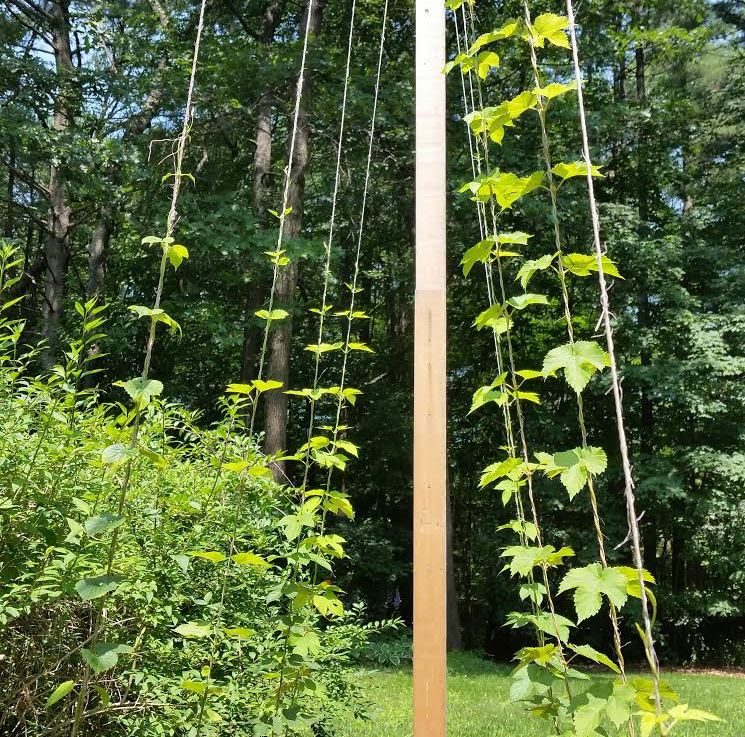
Since the very end of May, I’ve taken weekly measurements of the height of all of the first year hop bines in my test yard. Here are the results, by location and height:

Screen Shot 2015-07-12 at 12.11.12 PM

Like any pile of data, we come away with more questions than answers: are there significant differences between the locations that grew better and those that grew worse? Is there a variable at play that isn’t described by the graphic? In this case, I can tell you I hope not; they’re all watered automatically and at the same rate – I tested! They also all have nearly exactly the same amount of sunlight per day, due to the location and alignment.

However, it is neat to notice how the different variety of hop plant are growing differently: you can see that B2 and B3 are far outgrowing the others (at 85″ and 93″ respectively, versus a yard average of 41″ for this week) – these plants are both of the Chinook variety, described by my friends and yours at Hopunion as “A high alpha hop with acceptable aroma.”

We can also see that the two laggards (A1 and B1) are both Centennials (“Very balanced, sometimes called a super Cascade.”) – while I know that the first year’s growth is not necessarily indicative of any plant or variety’s long term success, it will be interesting to see how these trends correlate to yield in future years – it’s possible that the Centennial plants are pushing out more substantial root stock than the others, which may make this apparent first-year laziness in fact an investment in greater long term success.

Ain’t data fun?