To This, We Say Yes!

After a few failed attempts, The Doctor and I finally had a chance to watch a movie that I’ve been very excited about for some time: Jodorowsky’s Dune. Here’s the trailer:


Besides being a really wonderful documentary about a radical retelling of a story I’ve loved my whole life, it is also an exploration of a sort of genius that seems missing from today’s world: skating on the edge of insanity, blending Continental philosophy with art and literature and comics, finding and delivering meaning in unusual and sometimes delightful places.

I find Alejandro Jodorowsky inspiring for many reasons, not the least of which is his intense lifelong ability to simply ship prolifically – the man has published books, made films, collaborated with artists and scientists – but also his approach to his work, to The Work. He says two things in the documentary about his attempt at filming Dune that have stuck with me.

“Things come, you say yes. Things go away, you say yes.”

Jodorowsky’s approach is ever-progressive – not in a political way necessarily, but in terms of forward momentum. Even when Dune, what could have been a masterpiece, was canned, his response was Yes! If the world is a certain way, you must progress anyway – you must say yes! You must say yes even if you go on to change it. This approach shines positivity and momentum, two things I try to reflect upon and embrace in my own work, and my own thoughts. It encourages action, rather than reaction.

“Why not be ambitious?”

Alejandro is again responding to the documentarian’s questions about the failure of Dune, and even in the face of failure, he shows no regret or remorse. He does not wish that he had held back his ambition, that he had quieted his desires to make a consciousness-altering movie – he instead faces it with defiance and grit: why not be ambitious? Why be on this world if not to make world-changing things?

Jodorowsky’s Dune could have been great, and I do wish that it could have been completed, but the real thing I have taken from the documentary is an inspiration to have a little more Alejandro in my own life – to allow a little madness in around the edges, to allow myself to be ambitious and to grasp for great things, to make and discuss and get a little wild. To this, I say yes!


 

First Happiness Data Project

I’ve successfully harangued a pair of my colleagues (Rachel and Kevin) into getting our feet wet implementing some growth engineering tactics in our larger hospitality strategy. That strategy is, of course, to make WordPress.com customers the happiest customers in the world.

Here’s the 1.0 of the plan:

  1. Each of us will individually analyze the Google Analytics data for http://en.support.wordpress.com/
  2. From that data, we will each find what we see as the three documents with the highest traffic but also the highest bounce rate, indicating lots of views, and lots of departures from that document. The idea here being that these docs will either be the very best (customers problems are solved, and they go to their Dashboard to implement the solution) or the worst (customers simply abandon their search and head to Google. Or Buzzfeed. Probably Buzzfeed.)
  3. Add a pop-up survey to the bottom of each of these high-traffic-high-bounce sites asking general questions about the quality of the doc, feedback, etc. We haven’t sussed out these questions yet.
  4. Let the survey run for a few weeks, being vigilant to any support requests it might gather.
  5. Read the responses & confer with the documentation folks to work on improvements.
  6. Track the docs over time, watch for a change of bounce rate.

For a first dive, I’m hopeful. It will give us a chance to work together as a team, become familiar with the tools at hand (Google Analytics and Qualaroo, in this case), and hopefully iterate into bigger and better things!

Happiness Mastermind Group & Personal Mission Statement

One of the great things about living in the future is the rapid dissemination of information – for example, my colleague Dustin turned me on to the podcast Entrepreneur on Fire, which in turn lead me to learning more about Mastermind groups – and to eventually start one with some of my Happiness Engineer colleagues at Automattic.

We’ve only met once, though our second meeting will be in-person at next week’s Grand Meetup. The goal of our particular Mastermind group is accountability and goal-setting: in a company like Automattic, it’s easy to get caught up in the many, many ongoing projects and iterations. Having a group prepared to listen to one another’s goals and hold each other accountable will, I think, really bear a lot of fruit.

Our goals individually are interestingly broad; I’m taking a course in Google Analytics that I’d like to have finished by our next meeting, others in the group are building things using JavaScript or putting together entire WordPress Themes – the important thing is that we are moving forward and helping one another to accomplish our goals.

One piece of that that we discussed in our first meeting you can already see, above: we asked one another “What is your personal mission statement? Your broader vision for yourself?”

(This turns out to be a harder question than I had expected!)

In the end, I think my vision for myself is this; to use my background in operations management, as well as growth engineering principles, to revolutionize the way hospitality is done on the internet.

Big Week for Tech Valley!

IMG_0076.JPG

October is looking to be a big month for tech workers in the Capital Region – in particular the week of the fifth – with the first Level Up Conference taking place on Wednesday and Thursday (10/8 – 10/9), and also the first ever WordCamp Saratoga taking place on Saturday (10/11), there is an awful lot of potential for professional education, personal networking and of course, beers with friends old and new.

For those of you who are running the full gauntlet, Sharatoga Coworking in downtown Saratoga is also offering a free co-working day in their Broadway shared office space for folks who will be in town for both events!

Hopefully this can grow into an annual Power Week for technology workers in our area – it’s great to be a part of a growing community with this kind of energy!

Full disclosure: I am speaking at LevelUp, organizing WordCamp, and am a founding member of Sharatoga. I do not have a financial interest in any of these events or organizations.

Thinking about Funnels


Funnel_(PSF)

An idea that’s pretty popular among sales people and growth engineers is considering the journey your customers take toward their eventual purchase (or non-purchase) in terms of a funnel. Here’s an article that’s a good starting point to thinking about sales funnels.

Using the metaphor of a funnel , along with modern analytics and tracking software, allows us to think of the sales process as a precise thing: between Page One and Page Two we lose about 30% of our traffic, from Page Two to Page Three we lose another 40%, and then about 5% of the original folks from Page One tend to make a purchase. The Big Idea of a sales funnel is to make that final number, the final group of folks who make a purchase, as large as possible.

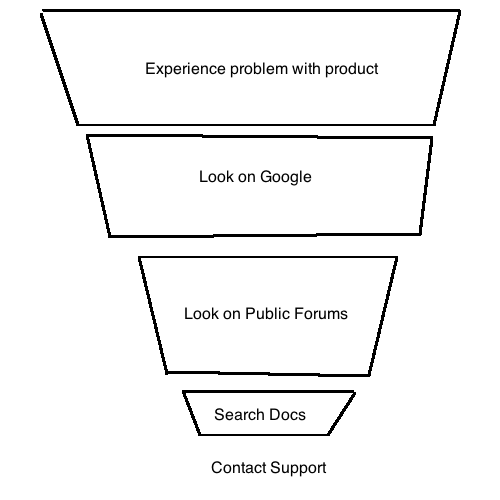
We can take this idea of a funnel and apply it to providing support to our customers as well, with an interesting twist; rather than the final count being our paying customers, we want to consider the final count as the folks who open a support request. In this way we flip the sales funnel on its head – rather than maximizing our final number, in support, we want to minimize this number.

It might look something like this:

serviceFunnel

Our goal, as folks who provide hospitality (and service!) for technology products, is to enable our customers to leave this funnel as early as possible. I am of the opinion that every customer who contacts support has already experienced two failures on our behalf: the product fails to fulfill some expectation that the customer has (it is just as much our job to set reasonable expectations as it is to make products easy to use), and then that problem is not easily solved with the tools we make freely available.

That means that for every customer who reaches the last step, Contacting Support, we’re already on our third strike. It’s our last chance to provide them a truly excellent experience.

If we start to co-opt the skills that our growth engineer brothers and sisters are becoming so good at, we can use those same skills to help our customers escape this funnel earlier and earlier: we do the job of hospitality the best when our customers never need us at all. This is the value of a good support funnel – it keeps us down to one strike, and that’s a win for everyone.