Author: Simon

Munging NASA’s Open Meteor Data

Munging NASA’s Open Meteor Data

In snooping around the US Government’s open data sets a few months back, I found out that NASA has an entire web site dedicated to their publicly available data: https://data.nasa.gov/

Surely, you understand why that would excite me!

I dug around a bit and pulled out some information on meteor landings in the United States, with tons of information, mass, date, lots of stuff.

To simplify the data set and make things tidy for R, I wrote a quick Python script to strip out some columns and clean up the dates. Here’s the gist if you want to have a go at the data as well.

I ended up looking to see if there was a trend between date and meteor mass, to see if maybe there were obvious cycles or other interesting stuff, but some super-massive meteors ended up shoving the data into pretty uninteresting visualizations, which is too bad.

We can do some simpler stuff, even with some super-massive meteors. For instance, here’s a log(mass) histogram of all of the meteors:

Screen Shot 2016-01-05 at 7.49.24 PM.png

Check it out! It results in a somewhat normal, slightly right-skewed distribution. That means we can use inferential statistics on it, although I am not sure why you would want to! The R code is a super quick ggplot2 script.

It’s pretty amazing how easily we can access so, so much information. The trouble is figuring out how to use it in an actionable and simply explained way. The above histogram is accurate, and looks pretty (steelblue, the preferred default color of data folks everywhere), but it isn’t actually helpful in any way.

Just because we can transform a dense .csv into a readable chart doesn’t mean it’s going to be useful.

2015: The Good Stuff

2015: The Good Stuff

This is the third chunk of my 2015 wrap up series. Here are my broad goals for 2016, and here are the things that I think I could have done better in 2015. 

My vision statement for 2015 was “Send value into the universe, selflessly.” Looking back today, in January 2016, I think that I stayed true to that vision statement. Both at work and at home, I spent a lot of time and brain power finding ways to create value, create connections between people, and unlock the treasures that were trapped inside their own little silos.

Like my list of things that could have gone better, I’m going to try to focus on things that I directly created or did, rather than simply thought about. These are the things that count, I think.

Continue reading “2015: The Good Stuff”

Lessons from 2015

Lessons from 2015

In taking some time to look back through my 2015 calendar and flip back through all of my posts for the year, I tried to sort things into two piles – things that went well, and things that didn’t go well.

Broadly, in my own life, I’m trying to focus more on things that are created, that move from the world of the mental into the world of the actual. I’ve tried to keep my went-well and didn’t-go-well piles limited only to that sort of thing, since it’s hard to say whether an idea “went well” if it did not result in any type of action or tangible outcome.

Continue reading “Lessons from 2015”

Looking Forward: 2016 and Beyond

Looking Forward: 2016 and Beyond

I figure I’ll put together a 2015 recap soon – there are a lot of calendars and old Posts and such to dig through before I really have a great grasp on what the year really was about.

What I’m doing here is putting together a quick bullet-point list of things I’d like to put on my big-picture to-do list for 2016, or at least the first half of 2016. I figure I’ll hash these out in greater detail as they become more focused, but for now I think an outline of how I’d like 2016 to go is appropriate.

Big Picture:

  • Have perpetual, recurring, family activities. Swim classes, regular rituals, etc.
  • Eat more, better food.
  • Make fitness a practice and not a means to an end.
  • Focus on fewer things, more deeply.

More measurable:

  • Produce side revenue of ~50% of my take-home salary.
  • Release an interview every Thursday.
  • Do at least 2 more 30 Day Challenges (maybe with d3? more R? Python?)
  • Publish twice weekly on s12k, focusing on remote work and remote leadership, with an average word count of > 500 words
Work Remotely: Shrink Your Office

Work Remotely: Shrink Your Office

I love working remotely. Working for Automattic is especially solid, since our entire company is distributed. There is no office anywhere, although we do have a building in San Francisco for events and visiting Automatticians.

Scott recently tweeted about one of the advantages that working remotely offers:

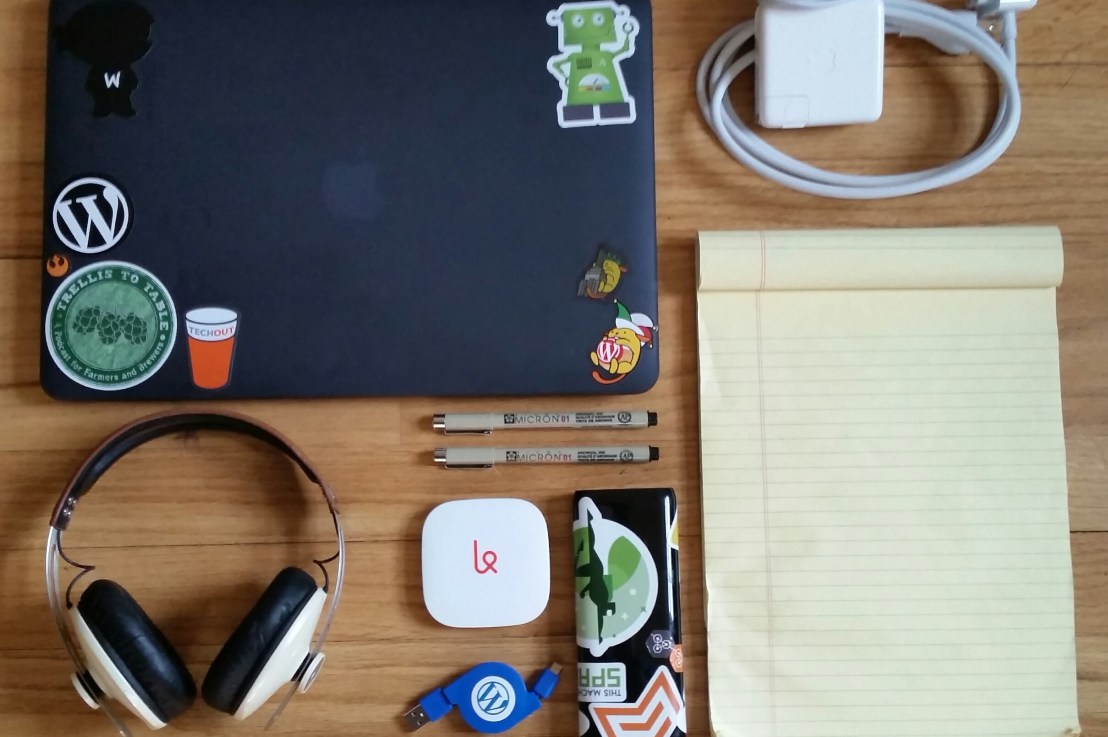
He’s absolutely right. Over the last two years I’ve shrunk my required inventory to be productive down to a pretty tiny footprint. Check it out:

Continue reading “Work Remotely: Shrink Your Office”