Tag: work

Documentation, Support, and Customer Success

oIpwxeeSPy1cnwYpqJ1w_Dufer-Collateral-test-1400x1136

I’ve had a bunch of conversations recently around the role of documentation in hospitality on the internet. My friend and colleague Andrew posted about documentation recently, and of course my love for Buffer requires I point out their approach to documentation – documentation is such a big deal in support communities that we even have a conference dedicated to it.

When it comes to documentation, I am of two minds. Software development, especially code languages and learning code languages, involve a lot of documentation, and a lot of referring to documentation, and so forth. We need to recognize, though, that when we use code to build really awesome things, we are building those things for an audience who is perhaps not as steeped in a documentation-heavy culture.

Working in support for WordPress.com, I am grateful every day for the documentation that we have – for little things that folks can work out for themselves if they have a guide (like, say, a custom menu or static front page), and certainly for big things that are challenging even for me (intricate Theme setups especially).

Lately, though, I have been shifting my thinking on documentation. Part of this comes from doing some deep dives in our Google Analytics account for our docs, finally getting a real bite of how huge our docs base is, and seeing for the first time how much traffic they really get (about 60,000 visitors per day). Recently I’ve started to see documentation as a psychological band-aid, and as a sidestep to improved products. Here’s what I mean:

Docs as a Psychological Band Aid
When a member of our staff recognizes that we have a flow, or a feature, or some other piece that requires additional education, and they invest their time and brainpower in creating documentation for that flow or feature, we can breathe a sigh of relief, right? Now, when a customer asks about that flow or feature, we have a resource for them. That problem is solved. Here you go – read this. We’ve scaled. We can check that box.

The problem here, is that when ever we feel like that box is checked, we calcify our thinking on that issue – we think it’s taken care of. A question about X? Here’s our documentation about X. Especially in a company where staff feels overworked and understaffed (ie, all of them), this becomes the path of least resistance, which then becomes habit. A habit of deferring replies to documentation has two unfortunate psychological consequences: first, it calcifies us in a place where critical thinking no longer takes place. More on this in the next point.

Second, it (inappropriately!) shifts the responsibility from us, as hospitality professionals, onto our customers. It is no longer our job to create an excellent environment where they can accomplish their goals – now it is the customer’s job to read the documents we created for them – time spent in documentation is time spent not accomplishing their goals.

Docs as Sidestepping Product Improvement
Every support document is an admission that a flow or feature doesn’t Just Work. When we create a long series of nested documentation on how to accomplish something is an indication that something is hard to do. A great company makes its customers feel smart, safe, and powerful. Taking someone out of your features, out of your flows, out of the path to their success, to refer to documentation represents a point of friction, an obstacle.

If you want to take the principles of Growth Engineering and apply them to doing hospitality right at your company, take a look at the top search terms in your Support page. Take a look at how people use those documents. Those are break points, those are places where a document is acting as a band aid to a better UX, or a better product (in this, we could learn a lot from modern computer and video games, but that’s a post for a different day).

So What Then?
I don’t hate documentation. I think for a lot of use cases it’s necessary, and it can be done really, really well. I do think that serving our customers to the very best of our ability, however, means reducing our documentation, approaching problems with ownership and a critical mindset – not “Well why don’t they read the guide?” but rather “Why does embedding this require a guide?”

Documentation can be a great tool in the Internet Hospitality Toolbox, but it’s only a temporary stopgap – Docs should be the clamp that holds two boards together while the glue cures, not the permanent solution.
The Only Rule is Work

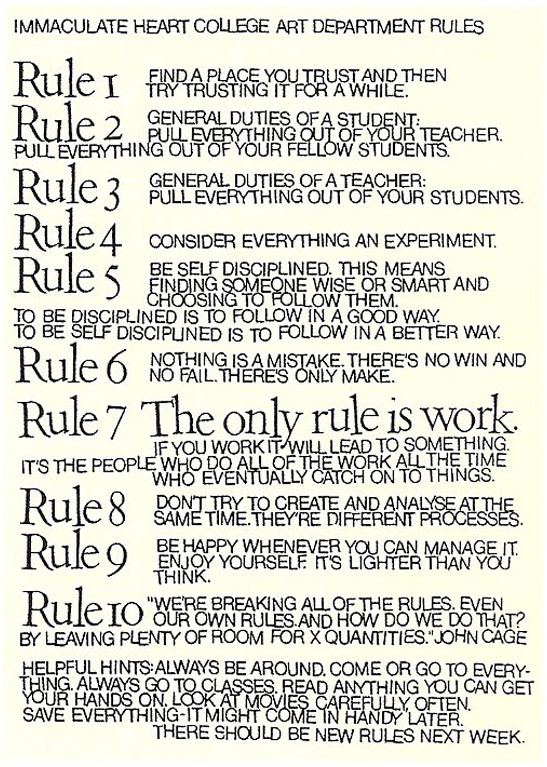
sistercoritarules1RULE ONE: Find a place you trust, and then try trusting it for awhile.

RULE TWO: General duties of a student — pull everything out of your teacher; pull everything out of your fellow students.

RULE THREE: General duties of a teacher — pull everything out of your students.

RULE FOUR: Consider everything an experiment.

RULE FIVE: Be self-disciplined — this means finding someone wise or smart and choosing to follow them. To be disciplined is to follow in a good way. To be self-disciplined is to follow in a better way.

RULE SIX: Nothing is a mistake. There’s no win and no fail, there’s only make.

RULE SEVEN: The only rule is work. If you work it will lead to something. It’s the people who do all of the work all of the time who eventually catch on to things.

RULE EIGHT: Don’t try to create and analyze at the same time. They’re different processes.

RULE NINE: Be happy whenever you can manage it. Enjoy yourself. It’s lighter than you think.

RULE TEN: “We’re breaking all the rules. Even our own rules. And how do we do that? By leaving plenty of room for X quantities.” (John Cage)

HINTS: Always be around. Come or go to everything. Always go to classes. Read anything you can get your hands on. Look at movies carefully, often. Save everything — it might come in handy later.

From the always fascinating Corita Kent.

5 Thoughts About Unlimited Vacation

Processed with VSCOcam with t1 preset

A post on Paper Planes got me to thinking about vacation, and the nature of paid time off, and the way that great ideas can collide with the real world in unexpected ways. I also took a second look at Jacob’s great post about open vacation policies when writing this post.

  1. Open (or unlimited) vacation policies have counterintuitive results: again and again it turns out that when folks are simply given no upper boundary on their time off, they tend to take about average offered elsewhere, or somewhat less than average.
  2. We’re social animals: even with an open vacation policy removing the limits that an employer places on an employee, there exist other limits. Specifically, how much time off does my boss take? What about other folks on my work team? What are the consequences of taking frequent or lengthy vacations? These limitations aren’t placed on the employee by the employer, but rather exist in the mind of the employee – and prevent them (us!) from taking as much time as we perhaps need – or deserve!
  3. “What is measured can be managed” has a reverse: to offer an unlimited vacation policy, and then proceed to track the days taken off, resonates in an uncomfortable way – if after all, the policy is unlimited, why track? If the goal is to avoid managing the days off taken by employees, then measurement seems dissonant with that goal. I acknowledge this may be the result of legal requirements placed on HR by outside bodies – which is a difference that makes a difference.
  4. Track or not to track? Jacob says you must track vacation days for a few reasons, but mostly to ensure that there isn’t any implicit (or explicit!) biases at work. Mathias reports that they did not track days at first, but ended up tracking days off in order to require them. Automattic does track time taken off, likely for the same reasons that Jacob espouses it.
  5. Minimums and Paid-Paid Time Off: Companies have started to take the above four points and push the open vacation idea to the next level – minimum vacations, as described by Mathias, where employees have 25 mandatory vacation days. Or Evernote, who pays employees $1,000 when they take a week off, to ensure, one imagines, that they relax to the max.

Some part of this discussion reminds me of the discussion in Freakonomics, where Dubner and Levitt discuss a day care center that had a small number of parents who would consistently arrive late for child pickup – in order to fight against this, they imposed a $3 fine, and the unexpected result was that even more parents arrived late, the day care center replacing a moral penalty with a tiny financial penalty.

When we remove the upper limit of paid vacation, and also remove the motivating factors of the use-it-or-lose-it system, folks are left only with their own interpretations and psychological barriers – which lead to fewer trips to Aruba. And no one wants that.

(Yes, Daryl, I read Mathias’ company as “Tavis” as well. )

Level Up 2014: Day One Reflections

logo-lg@2x


This Wednesday and Thursday (aka today and tomorrow) is the first ever Level Up Conference, a “creative tech conference” put on by my friends and yours, the folks at Mad Glory. I mentioned this crazy week a while back, since it is not just the first ever Level Up, but also the first ever WordCamp Saratoga (on Saturday, tickets still available!)

(Yes, Mad Glory and Sharatoga share a street. Maybe we should start a collaborative project with us and the ever-relevant Hatties Fried Chicken – Phila Phriends? One can dream)

First, let me address how wonderfully this conference has been organized. It does not feel like their first run through: it’s polished, it’s seamless, and it really feels like the Mad Glory team are old pros at this. I’m sure they’re putting out fires backstage silently, but from the perspective of an attendee, it really seems and feels flawless. They even provided umbrellas. Umbrellas!

Second, and this may be because I’m primed with visions of Jodorowsky and fearless positive forward movement, but this first day for me has been all about facing and defeating fear – your own fear as well as the fears of your coworkers and clients. I hope to write some more in-depth pieces on some of the presentations more specifically, but right now, I’m trying to find a bigger sense of synthesis.

I wasn’t really sure what to expect about Level Up – I knew that I had (still have!) tremendous respect for the Mad Glory team, and that whatever the event turned out to be it would be interesting and certainly worth attending, but I didn’t expect the sort of macro, high-level sort of discussions that are taking place. I expected plain lessons on creation and ideation and shipping, but what we’re having are conversations about human psychology and the nature of fear in The Work and the way that we think about ourselves, as well as the way that we think about The Product as a bigger, abstract idea, not just as a piece of finished or unfinished code.

It’s heady stuff, blurring the line between leadership and design and philosophy – but that’s where I live. It’s where we all live, after all, and to be surrounded by folks who share that experience and who are excited to chaw on it is a really excellent experience.

And it’s in Upstate New York. I can’t wait for tomorrow.


Tickets Non-Ownership: New Data!

I am lucky in that I have some seriously smart coworkers – working at Automattic is a constant gut-check; the level of drive, creativity and ability are at a very high level. It would be exhausting if it weren’t so inspiring. We’re all lucky to work somewhere where we’re given time to work on side projects – in fact, some of these side projects take the form of project-based meetups, where a crew of Automatticians travel to a new city, and buckle down to work toward a goal.

I’m secondarily lucky that one of these project meetups came to a close at the end of last month, and some members of my squad came home with some very interesting insights. They had spent a week diving into the mountain of data that we have on feedback from our customers, looking for correlations. What was most closely associated with happy customers? How could we better calibrate ourselves to what makes our customers happy?

Data!
Data!

Admittedly, this is not the cleanest data set: the feedback mechanism leaves something to be desired, and that is certainly on our radar. But, this is the data that we have, and after some validation and cleaning up, they came to a surprising conclusion:

Reported User Happiness was most closely tied to the length of time between our first response, and resolution. 

Why is this surprising? Because it turns out that the amount of time between a customer submitting a support request and when they first hear back from us is does not appear to be not all that impactful: falling around .1 points per day (on a 10-point scale.) That’s only a 1% loss per day.

When a customer has heard back from us, time passing has a much greater negative impact, going from an average of 8.8 after 24 hours to 8.0 in our largest queue. That negative impact is eight times greater than the same amount of wait time between their submission and our first response.

This data indicates to me that the idea of leveling the wait time across all tickets is not the right approach: it assumes a roughly even wait time sensitivity regardless of the ticket’s state. This does not seem to be the case: our customers do not mind a bit of a wait to hear back from us, but once they’ve heard – they want our full attention.

The question remains: how do we move forward with the lessons from April and the implications of this new data?