Category: Play

Google Analytics for Science from Scientists

Google Analytics for Science from Scientists

In January, I had an opportunity (through Catchafire) to work with the science education nonprofit Science from Scientists. They had recently set up a Google Analytics property on their web site, and were looking for a volunteer to get things running properly.

Working with their Director of Web Services, I developed:

  • Custom Dashboards to track engagement, donations, lesson plan usage, and geographic interest.
  • Automated email reporting to various staff members and departments.
  • A Campaign Tracking URL builder.
  • Educational screencasts for all of the above.

Today, I’m happy to click the “Project Complete” button at Catchafire, setting Science from Scientists to sail, equipped with a batch of customized data delivery utilities and the educational resources to make use of them in the future.

You can see my Catchafire profile here.

New York State Hop Farmers and Thinking Like a Founder

Hopfendolde-mit-hopfengarten

Like many avid gardeners, I harbor a secret belief that I can someday make money on gardening’s big brother, farming. Since The Doctor and I have somewhat recently come into some acreage in Madison County, NY, my fantasy of someday becoming a gentleman farmer, growing hops (barley’s bitter buddy in brewing beers) is starting to become even more realistic – or at least in the realm of reality.

So, in an effort to educate myself a bit on the process and atmosphere of hop farming in the Northeast, I shelled out to be a remote webinar attendee for this year’s conference of the Northeast Hop Alliance. I learned a lot, and you can look for future blog posts on this topic, and I think there’s a disruption opportunity in boutique aroma hops, but that’s for another day.

One of the speakers, Rick Pedersen of Pedersen Farms, had a lot of great, practical advice about how to plant posts and burn crowns, but his mindset, especially when advising younger farmers, struck me as equally valuable for today’s entrepreneurs, wantrepreneurs, and future founders. That advice was this:

Plan to be big enough to be relevant. 

This really resonated with me – if you’re going to build a business, whether it’s agricultural or technology or distribution, plan to be big enough that people will care. Make your plans too big to ignore. With size comes efficiency and a certain practical inability to be ignored. If you want to make a difference in your industry and in your community, don’t plan for small things. Demand this of yourself.

Getting Started with SQL

Startup Stock Photo

If you’re interested in data, you’re going to have to learn to interact with data one way or another – there are an awful lot of tools out there, and many are optimized for certain professions or fields. The Doctor uses SPSS for her analysis, but she’s an academic psychologist – not a super useful tool for folks interested in growth. For me, working at WordPress.com, SQL seemed like a great place to start, since many of the WordPress foundations are built on plain old SQL tables.

There are lots of places where folks will be very glad to take your money to teach you SQL (or anything else, for that matter) – in matters of education, I would encourage you to examine your options, and to at least get a taste of the no-cost options. With the Internet as it is, there is such a wealth of information and generosity of spirit, a dedicated and motivated learner can often find themselves with more than enough educational resources at their fingertips.

For me, I started with Khan Academy’s Hour of Code on SQL – available here – KA really does a great job, and the subjects they cover are growing every day. Once you’ve spent an hour with them, if you’re following my footsteps anyway, you’d want to move on to SQL Zoo, a wiki-style educational series of problems and a number of different databases to play with.

After SQL Zoo, I’m not sure! Are there other resources that you would recommend for a data-driven autodidact?

Notes from A More Beautiful Question Pages 1 – 88

2015-01-Life-of-Pix-free-stock-photos-measuring-instruments-navigation-wall-julien-sister

– Five Habits of Mind: Evidence, Viewpoint, Connection, Conjecture, Relevance. There is value in recognizing a system or process behind questioning and then evaluating those questions. Essentially, looking at my questions, and rather than immediately pursuing an answer, considering the question itself.The big one is Relevance – “Does this matter?” 

– There’s a real value in recognizing the answer that sometimes comes packed in a question – this is the difference between an open and closed question. Consider, “Why is torture effective?” vs. “Is torture effective?” The way a question is asked will result in different answers, and can reveal much about the questioner.

– Asking questions online is different – and easier – than asking questions in person. This is because it allows for a certain amount of anonymity. Especially in work or social cultures where asking questions can indicate weakness, being able to anonymize questions opens up a whole realm of possibility. This reminds me of Gladwell’s Cockpit Culture from Outliers.

– Great quote from Edwin Land, founder of Polaroid, from 1942: “If you dream of something worth doing and then simply go to work on it … if you think of, detail by detail, what you have to do next, it is a wonderful dream even if the end is a long way off, for there are about five thousand steps to be taken before we realize it; and start making the first ten, and stay making those twenty after, it is amazing how quickly you get through those five thousand steps.”

– It’s great to see the power of habit discussed, especially in terms of questioning our long-ingrained ideas. These habits and ideas get caught in a groove, and become psychologically calcified, invulnerable to questioning not because they are the best answers, but simply because they always have been. And that’s not a great reason.

– More on that: “It means thinking of things that are usually assumed to be negative as positive, and vice versa. It can mean reversing assumptions about cause and effect, or what matters most versus least. It means not traveling through life on automatic pilot.

The Only Rule is Work

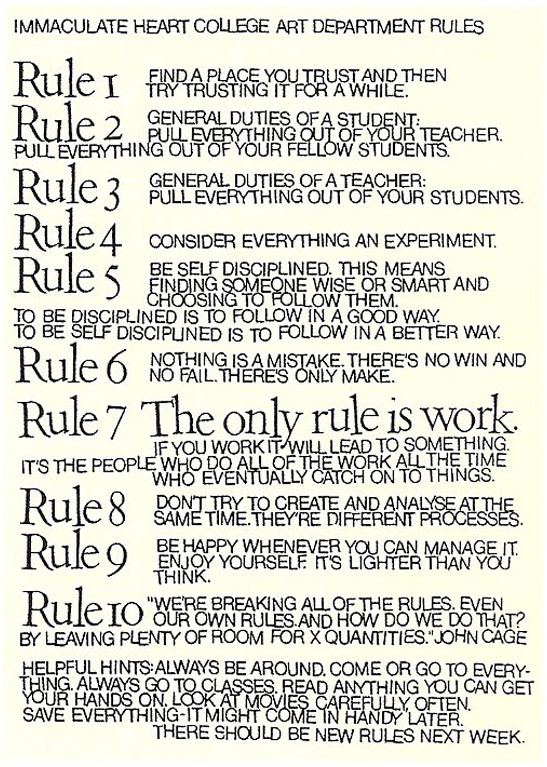
sistercoritarules1RULE ONE: Find a place you trust, and then try trusting it for awhile.

RULE TWO: General duties of a student — pull everything out of your teacher; pull everything out of your fellow students.

RULE THREE: General duties of a teacher — pull everything out of your students.

RULE FOUR: Consider everything an experiment.

RULE FIVE: Be self-disciplined — this means finding someone wise or smart and choosing to follow them. To be disciplined is to follow in a good way. To be self-disciplined is to follow in a better way.

RULE SIX: Nothing is a mistake. There’s no win and no fail, there’s only make.

RULE SEVEN: The only rule is work. If you work it will lead to something. It’s the people who do all of the work all of the time who eventually catch on to things.

RULE EIGHT: Don’t try to create and analyze at the same time. They’re different processes.

RULE NINE: Be happy whenever you can manage it. Enjoy yourself. It’s lighter than you think.

RULE TEN: “We’re breaking all the rules. Even our own rules. And how do we do that? By leaving plenty of room for X quantities.” (John Cage)

HINTS: Always be around. Come or go to everything. Always go to classes. Read anything you can get your hands on. Look at movies carefully, often. Save everything — it might come in handy later.

From the always fascinating Corita Kent.